
Paul Maziar – Junebug (preorder)
Paul Maziar – Junebug (preorder)
Junebug situates Paul Maziar’s latest acts of listening and attending, transmission and transcription. He’s built a modular space suggestive of both the theatre and the gallery, performance and (inter)play. The aphoristic title sequence hones sharp accessibilities — we find words available to us, for our limbs and limbics to hold, hurrumph, to slap our knees and share. A mysterious dramatis personae pervades Junebug’s expanse across the mental maps Maziar graphs as he organizes streets of words and questions what their design might reference. We encounter, among others, Toulouse-Lautrec, Agnes Martin, Eva Hesse, Jack Whitten, Colette, Robert Walser. Who are all these characters in Maziar’s parade? Maybe there’s some insight in the final serial sequence, “Hives,” which states that “The real thing is inside of what everything appears as.” The real in Junebug asks us to admire the distance between the surface and the subject. We already have the right tools.
When asked for eight words to describe Junebug, Maziar channeled Agent Cooper: “Everyday, once a day, give yourself a present.” But did he mean the present? Either way, Junebug is a gift.
7.5 x 5 inches. 112 pages.
Paperback
ISBN: 979-8-9959310-0-3
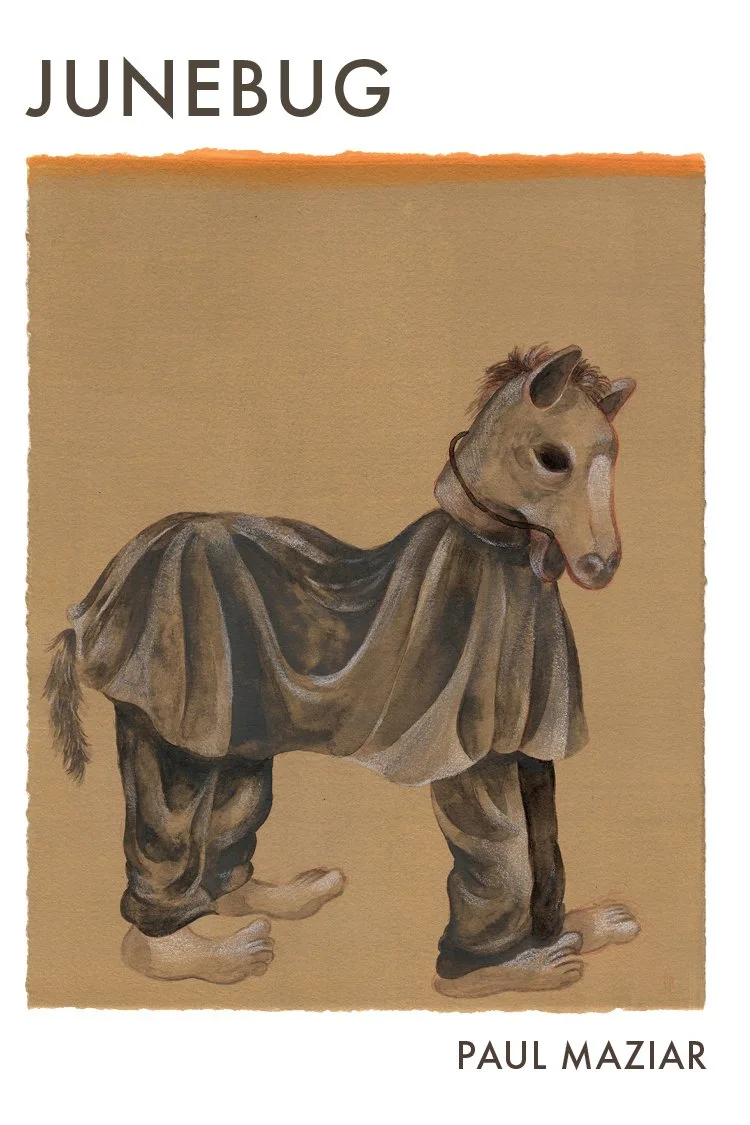
Cover art by Emily Harter, courtesy of the artist and HESSE FLATOW, New York.
Advance praise for Junebug:
Charles North: From short poems to prose poems to the wonderful fragments collected in its title poem, Paul Maziar’s writing revels in imaginative discontinuity. Junebug is smart, witty, surprising—and inspiring—throughout.
Merrill Gilfillan: These works step up in the name of Poetry and its heartwood, its ever-salvational “What’s on the river today?”
Tetra Balestri: Maziar manages to resurrect a conversation started sometime in the early to mid-20th century that cuts through the present-day pandemonium with polish and swagger. Junebug is a pair of pants worth trying on.
Simone Kearney: Reading Paul Maziar’s Junebug, I feel the tightrope walker’s high-wire balance between the forces of levity and gravity, the contexts of interior and exterior, the concocted and the perceived, thought and overheard speech. These poems make me wonder how it is that we move through the world, which is also a moving-through language.
I’m reminded that language bears a strange mystery. It’s always received and always being made at the same time; it’s a material we inherit and get to play with. In Maziar’s work, overheard phrases and sayings arrive solidified, brick-like things. The language resembles the fragments of familiar tunes — an echo, or memory of one — appearing as the freshest, strangest thing newly imagined.
I feel the intimacy and elusiveness of unspoken thought in the poems: words not yet uttered, still inside the mind. This makes me feel the dynamics of inside and outside that are part of the human drama. Am I looking at something the poet is looking at, or am I inside his head? Maziar lets us inhabit uncertainty. This is living language just being breathed, catapulted from lips, cemented into freshly-thought speech.
Junebug lets me delight in the way language can tend to trip over itself: “I’d rather stimulate than simulate”; “a certain vigor (or vinegar?).” Decontextualized, speech is absurd, funny, strangely moving: “I’m not going anywhere until I see a horse.”
What emerges is a tour de force composed of song, slogan, slip of the tongue, reverie, note, advertisement, fragment, nonsense, musing, hiccup, rupture, tidbit, epiphany. “The only faith he had was in the confusion of his experiences,” Maziar writes, suggesting that one thing we can do amid such confusion is continue to place words onto the page — in relation to ourselves, to others, to images, and to other words. And those words keep coming to meet us: flat, full, flowing, tired, zippy, and ready for more.
Praise for Paul Maziar
Kit Robinson: Paul Maziar’s poems communicate fluently across bursts of interruption, code-switches, and second thoughts. What gets communicated is an aesthetic of exuberant nonchalance, a devil-may-care attitude that is as attractive as it is elusive. Inner and outer realms converge to paint a cubist picture of experience, alternately dreamlike and awake to possibility, both current and buried deep in the past. “I wake up / a funny form / on a flat speck / of red silt / a million or more years on…” Maziar’s sensibility, refined through his work as an art critic, is relaxed and alert. It’s a breath of fresh air.
Katherine Bradford: The world Paul writes about is the one I desire to live in. He is drawn to expressions of fear and vulnerability, to artist weirdos, to the strange beauty behind the experience of not knowing. I found the book transporting.
Cedar Sigo: I hear an unerring genius for phrasing in this voice, a poet brimming with charm and ‘self-selecting’ vividness. I am reminded of the work of Eileen Myles, Pierre Reverdy, and John Wieners. The voice is being reshuffled to the point of constant motion, like when a notebook poem just fits together endlessly, and the poet can even speak through someone else’s text with an alarming clarity. Paul Maziar introduces a new way of making poems through addition, subtraction, and through the beheading of storytelling. He is a true hero locked in his quest. Quick Millions is dripping with magic — get a handle on it as quickly as you can.
Jarrett Earnest: Paul Maziar's ONE FOOT is a chatty carousel, covering the last ten years of art in and around Portland, Oregon. Tumbling between observation, reflection, and digression, he tells the stories of what it's like to be there, in front of that painting, in that art scene, in the second decade of the twenty-first century. This has the great advantage of being a critic's 'first' book, where the reader shares in working out foundational concepts of whatever 'art' or 'painting' or 'writing' is or might be. As Maziar says of Marcel Duchamp's 'shaved' Mona Lisa—‘I like that he did this.’
Trevor Winkfield: With no political or aesthetic agendas to ram down our throats, Maziar’s generous eye detects the best in a varied menagerie of both famous and lesser-known artists and writers. He’s the kind of guide whose quiet enthusiasm one quickly learns to trust.
